Rapyd Powered Terminals for In-Person Payments
Introduction
Rapyd offers multiple integration models to support a wide range of payment use cases, from fully custom terminal integrations to Rapyd-managed terminal solutions that significantly reduce certification overhead. Depending on your technical requirements, desired level of control, and time to market, you can choose between a direct integration requiring Level 3 (L3) certification or several Rapyd-managed approaches that eliminate the need for L3 certification while still offering flexibility and scalability.
Direct Integration
Integrate your own payment terminal or payment gateway directly with the Rapyd API. This approach requires Level 3 (L3) certification once the integration is complete to ensure compliance with card network and security standards.
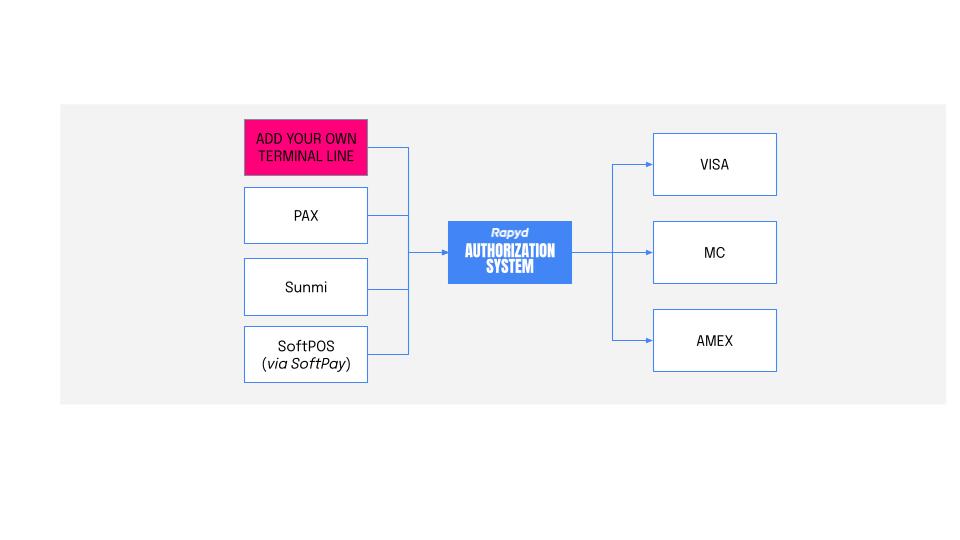
Adding support for other terminal manufacturers is possible by building integrations to Rapyd’s authorization systems.
Rapyd Managed Terminal Solutions
Note
This section refers to terminals that do not require an L3 certification.
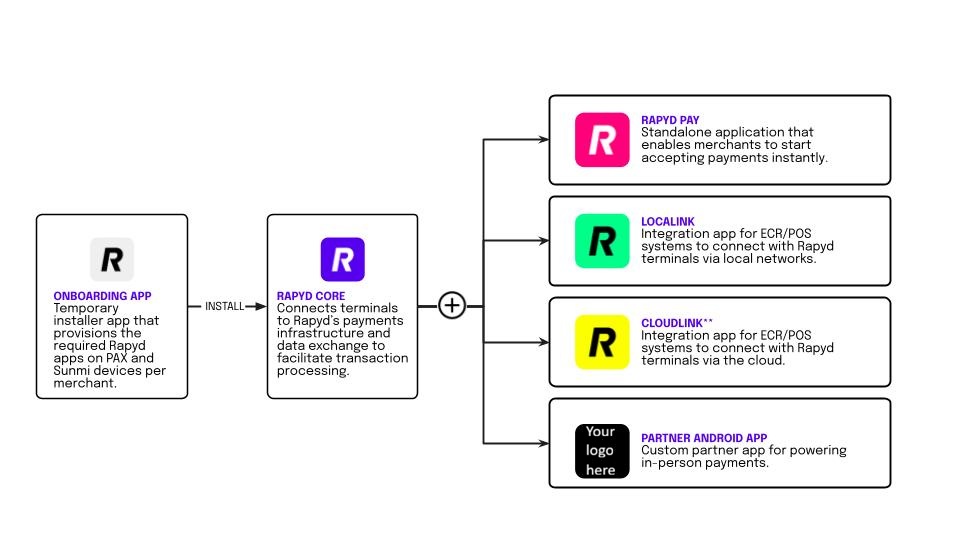
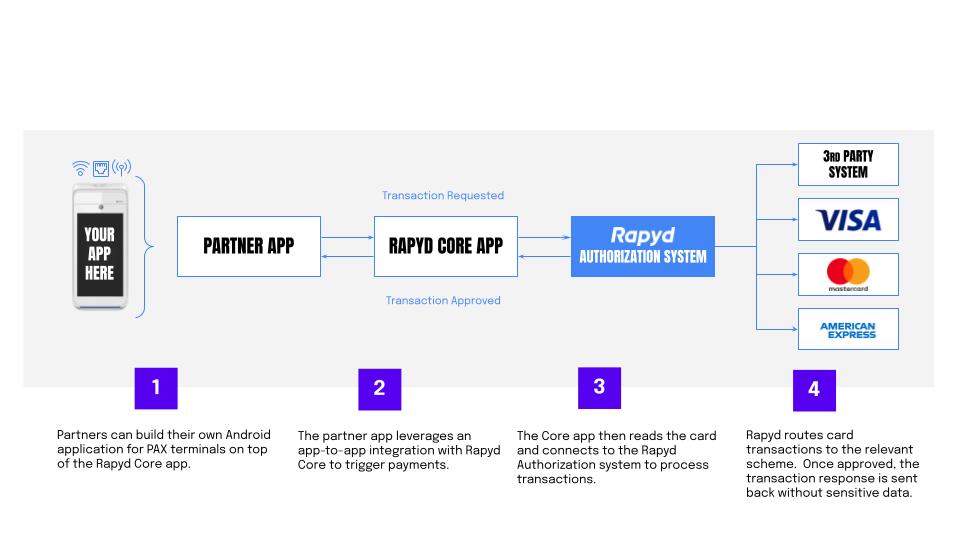
App-to-app integration using the Rapyd Core payment application running on Rapyd payment terminals. In this setup you build your own Android application which communicates via app to app with the Rapyd Core in charge of processing the payment. See App-to-App Integration Guide.
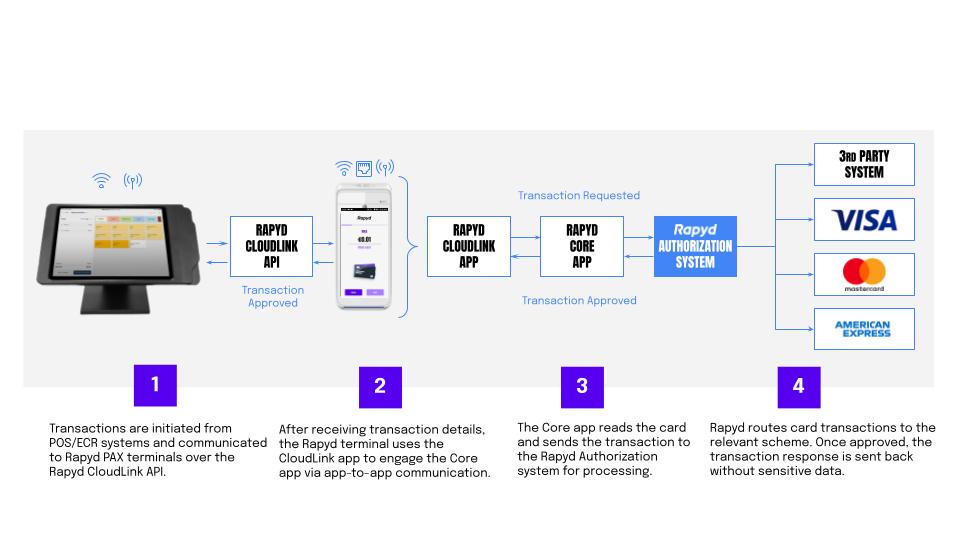
Cloud-based integration between an ePOS/ECR and the payment terminals using Rapyd’s CloudLink solution, enabling communication over the internet without a local network dependency. See CloudLink.
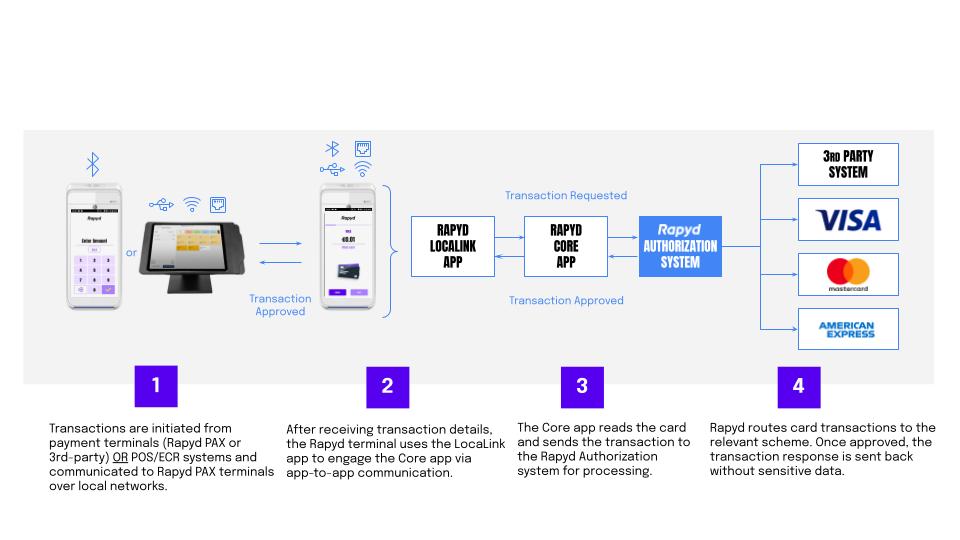
Local network integration between an ePOS/ECR and the payment terminals using Rapyd’s LocalLink solution, allowing direct communication within the same local network or via USB. See LocalLink.
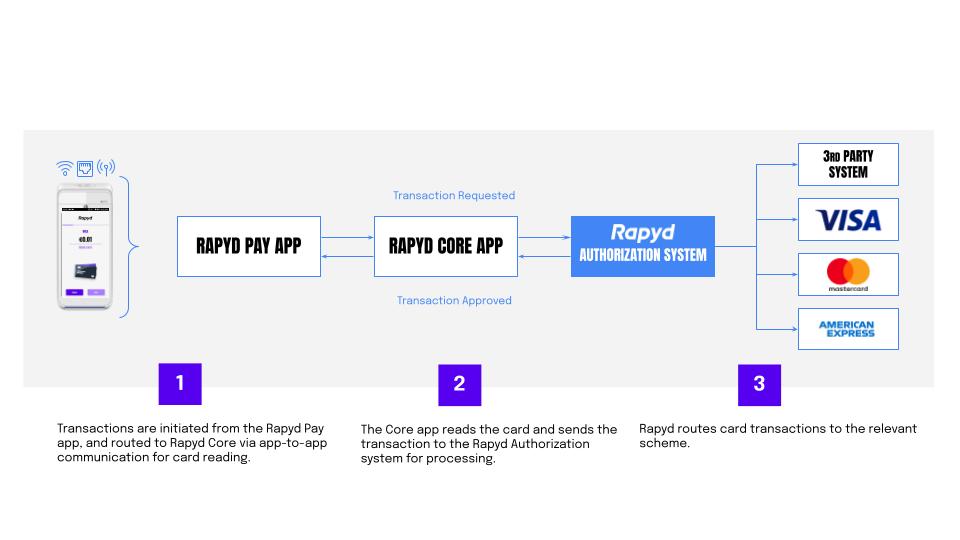
Standalone terminal application using Rapyd Pay-, Rapyd’s standalone payment application that operates independently of an ECR or ePOS system allows merchants to type in an amount and process a transaction. See Rapyd App Guide.
All Rapyd applications—including Rapyd Core, CloudLink, LocalLink, and Rapyd Pay—are fully brandable, allowing partners to customize the look and feel to match their own brand and merchant experience.
Leveraging the Rapyd apps speeds up the time to market when deploying a new payment application because it is already pre-certified for EMV (level 3 certification). It is therefore not required to integrate to the low level card brand kernels and go through lengthy certifications. No sensitive data is returned back as part of the transaction response from the Rapyd apps, which keeps partners out of PCI scope.
PAX Terminals
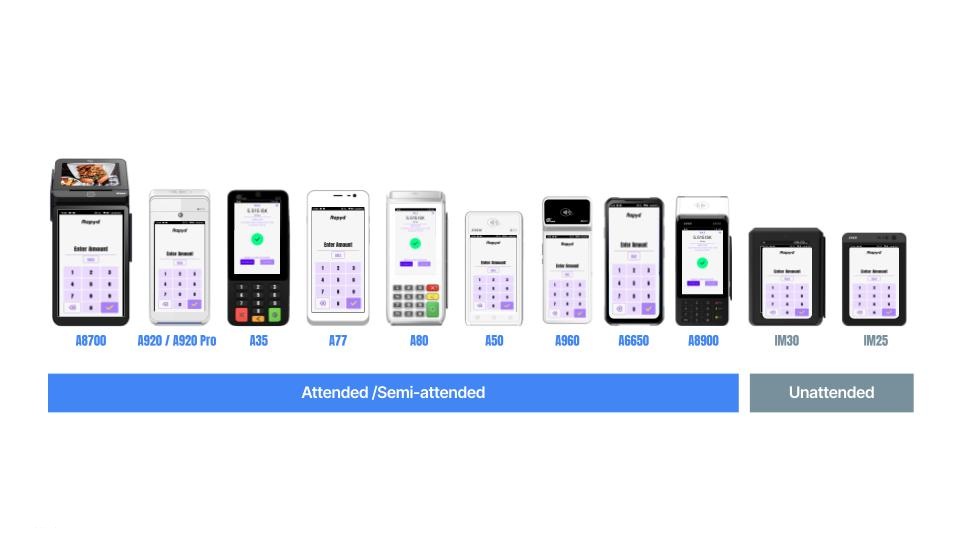
Attended/Semi-Attended and Unattended
SUNMI Terminals
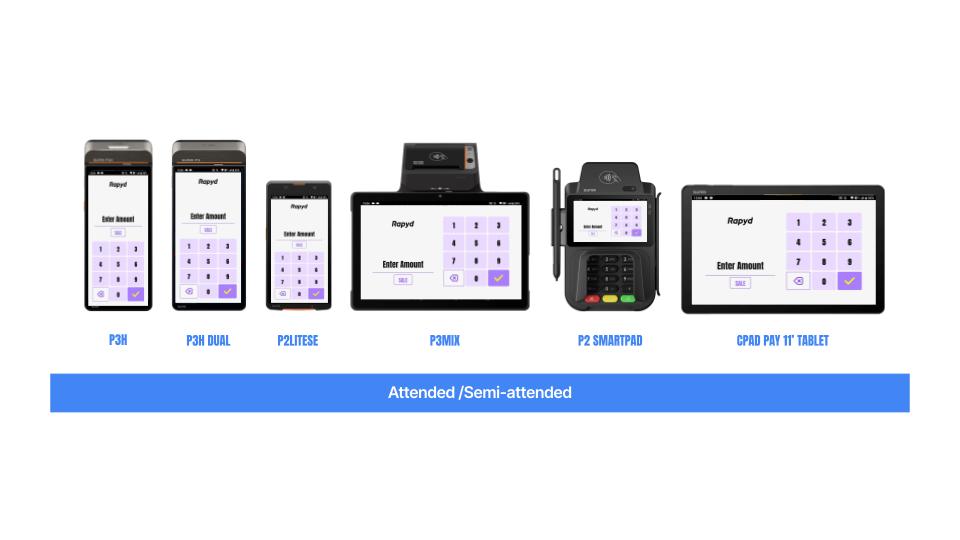
Attended/Semi-attended
The Rapyd App Suite for Payment Terminals
Detailed Features
Transaction types:
Sale
Refund
Void/Reversal
Pay by link (QR Code / SMS)
Offline payments
Pre-authorisation - coming soon
incremental authorisation - coming soon
Capture - coming soon
MOTO (key entry) - coming soon
Dynamic currency conversion (DCC) - coming soon
App features:
Fully brandable
Split billing
Tipping
Multi-languages support (20+)
Flexible receipt printing
List of transactions
Digital receipts
Password protection for refunds and reversals
Custom card acceptance rules (e.g no debit )
Define volume rules per transaction type (e.g max refund amount)
Multi merchant setup - coming soon
Address verification - coming soon
Settlement and reports:
Automated batching of transactions
X report
Z report